Regulatory and standards organisations have long recognised the validity of the MPN approach. Variants of the method are described in FDA, ISO and compendial guidance documents, (European, British and US pharmacopeia) particularly for applications where membrane filtration or plate counts are impractical. The FDA’s Bacteriological Analytical Manual 4, for example, provides extensive statistical tables and guidance for interpreting MPN results, including the treatment of confidence intervals and extreme outcomes.
Method overview: MPN test structure
Although details vary according to application and target organism, the classical MPN method consists of three sequential stages 5:
1. Presumptive test
2. Confirmed test
3. Completed test
This tiered approach reduces the risk of false positives while increasing confidence that observed growth is attributable to the organism of interest. The basic approach is illustrated in Figure 1.
Confirmed test
To improve specificity, material from positive presumptive tubes may be transferred into a more selective medium and incubated under conditions that favour the target organism while suppressing non target flora. This step is particularly important in environmental and water testing, where mixed microbial populations are expected.
Growth at this stage supports the conclusion that the presumptive positive result was not due to non specific organisms, strengthening confidence in the result.
Completed test
In some protocols, a completed test is performed to confirm the identity of the organism through additional cultural or morphological characteristics. While this step is essential in public health and water safety testing, its relevance in pharmaceutical applications depends on the purpose of the test and the criticality of organism identification.
Statistical interpretation and use of MPN tables
Once incubation is complete, the pattern of positive and negative tubes across all dilutions is recorded, typically as a triplet or similar numerical sequence (e.g. 3 2 0 positive tubes across successive dilutions). This pattern is then compared against published MPN tables, which provide the most probable estimate of the original microbial concentration, along with 95% confidence intervals.
It is important to recognise that different test designs (e.g. 3 tube, 5 tube, or 10 tube series) and dilution schemes require different tables. Modern implementations may use validated spreadsheet calculators or software tools derived from the same statistical principles, but the underlying logic remains unchanged.
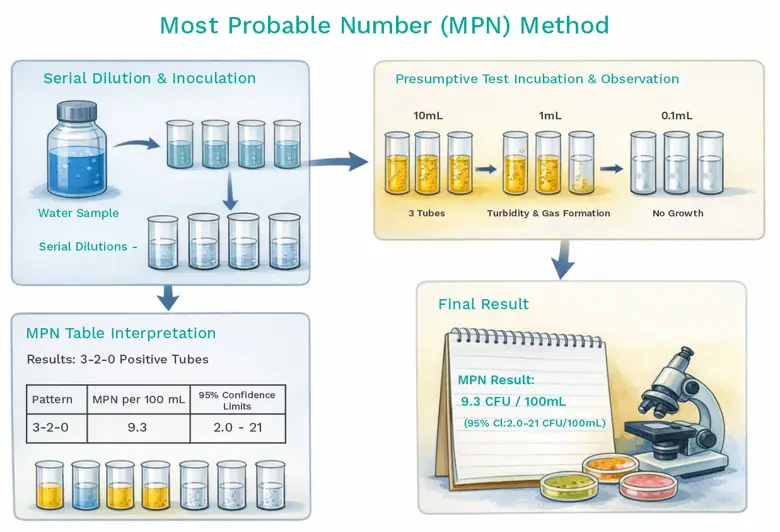
Figure 1: Illustration of the MPN method (digitally created by Tim Sandle)
Applications in pharmaceutical and environmental microbiology
Water systems: One of the most common applications of MPN in regulated industries is the examination of drinking water, purified water and other utility systems. The method is particularly valuable when water samples contain particulates, disinfectant residues or low organism numbers that challenge membrane filtration or plate count methods.
Process samples: MPN has also been used for specialist applications such as the enumeration of slow growing or stressed organisms where direct plating is impractical or insensitive.
Turbid or particulate samples: Where samples are highly turbid, oily or contain suspended solids that interfere with colony formation or filter integrity, MPN provides a practical alternative that avoids these physical limitations.
Worked example: MPN calculation
In this scenario, a water sample is examined for microorganisms using the MPN method because the sample is slightly turbid and unsuitable for membrane filtration. A 3 tube MPN design is selected, using three serial 10 fold dilutions of the original sample.
Test design
- Dilution levels tested:
- 10 mL sample per tube (undiluted equivalent)
- 1 mL sample per tube
- 0.1 mL sample per tube
- Number of replicate tubes per dilution: 3
- Growth medium: Suitable liquid medium with growth indicator
- Incubation: Defined temperature and time per method
After incubation, each tube is classified as positive (growth observed) or negative (no growth observed).
Results observed
| Sample volume tested |
Number of positive tubes (out of 3) |
| 10 mL |
3 |
| 1 mL |
2 |
| 0.1 mL |
0 |
This result pattern is therefore written as: 3 – 2 – 0
Use of the MPN Table
To determine the microbial concentration of the original sample, the observed 3 2 0 pattern is compared against the appropriate 3 tube MPN statistical table (for 3 consecutive 10 fold dilutions). From standard published MPN tables:
- MPN index corresponding to 3 2 0 = 9.3
- Reporting basis: per 100 mL of original sample
Final MPN result
Most Probable Number (MPN) = 9.3 microorganisms per 100 mL
This value represents the statistically most likely concentration of viable microorganisms in the sample, based on the observed growth pattern.
MPN results are always estimates and must be interpreted with their associated uncertainty. For a 3 tube MPN design:
- 95% confidence interval (from the same statistical tables):
- Lower limit ≈ 2.0 per 100 mL
- Upper limit ≈ 21 per 100 mL
Reported result (with confidence limits):
MPN = 9.3 CFU/100 mL (95% CI: 2.0–21 CFU/100 mL)
With this outcome, increasing the number of tubes (e.g. a 5 tube or 10 tube design) would tighten confidence intervals but increase resource use.
Advantages of the MPN method
The continued use of the MPN approach reflects several inherent strengths:
- Suitability for turbid or particulate samples where plating and filtration fail
- Sensitivity at low microbial concentrations
- Established regulatory and historical acceptance
- Ability to detect stressed or injured organisms that may not readily form colonies on solid media
These characteristics explain why MPN persists in standards and guidance documents despite advances in rapid microbiological methods.
Limitations and sources of uncertainty
MPN has some recognised limitations:
- Results are statistical estimates, not direct counts
- Confidence intervals can be wide, particularly at low tube numbers
- The method is labour intensive and relatively slow compared with modern rapid techniques
- Interpretation requires careful adherence to statistical tables and assumptions
Understanding these limitations is essential when incorporating MPN data into trending, quality decision making, or contamination control strategies.
Future of MPN
When applied appropriately, the method supports assessments of water system hygiene, environmental control and process robustness, particularly where alternative enumeration methods are compromised. While newer rapid and automated systems continue to reduce reliance on classical growth based techniques, the MPN method remains a useful approach.